
Application of artificial neural network in fracture pressure prediction
Abstract
Prediction of formation fracture pressure is an essential task in designing safer drilling operations and economical well planning, allowing effective control, operation and stimulation. Errors in fracture pressure prediction can lead to several serious problems such as lost circulation and kick, and even blowout.
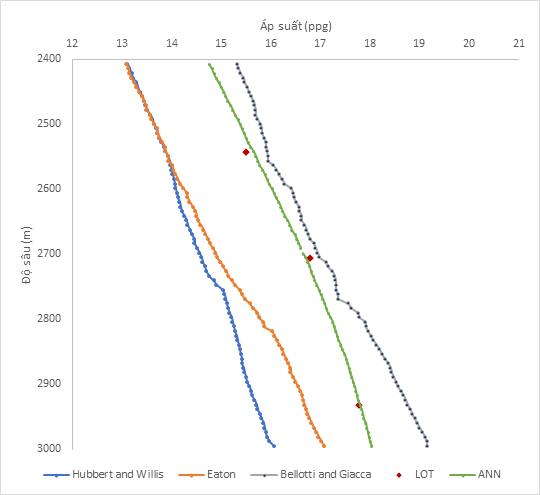
This paper presents an overview on application of artificial intelligent in the petroleum industry. Then an artificial neural network model will be used with depth, overburden stress, Poisson’s ration, and pore pressure as the input data and fracture pressure as the output data of one well in Nam Con Son basin for predicting formation fracture pressure. The results obtained from the model are compared with those obtained from conventional method. The comparison shows that the ANN method is promising and under some circumstances it is superior to the available techniques.
References
2. E.S.Pennebaker. An engineering interpretation of seismic data. Fall Meeting of the Society of Petroleum Engineers of AIME, Houston, Texas. 29 September - 2 October.
3. Ben A.Eaton. Fracture gradient prediction and its application in oilfield operations, Journal of Petroleum Technology. 1969; 21(10): p. 1353 - 1360.
4. W.R.Matthews, John Kelly. How to predict formation pressure and fracture gradient from electric and sonic logs. Oil and Gas Journal. 1967: p. 39 - 43.
5. L.A.MacPherson, L.N.Berry. Prediction of fracture gradients from log derived moduli. The Log Analyst. 1972.
6. Stan A.Christman. Offshore fracture gradients. Journal of Petroleum Technology. 1973; p. 910 - 914.
7. R.A.Anderson, D.S.Ingram, A.M.Zanier. Determining fracture pressure gradients from well logs. Journal of Petroleum Technology. 1973.
8. P.Bellotti, D.Giacca. Seismic data can detect overpressures in deep drilling. Oil and Gas Journal. 1978.
9. E.M.Shokir. Neuron network determines shaly-sand hydrocarbon saturation. Oil & Gas Journal. 2001.
10. Henrique V.da Silva, Celso K.Morooka, Ivan R.Guilherme, Tiago C.da Fonseca, José R.P.Mendes. Leak detection in petroleum pipelines using a fuzzy system. Journal of Petroleum Science and Engineering. 2005; 49(3 - 4): p. 223 - 238.
11. S.J.Cuddy, P.W.J.Glover. The application of fuzzy logic and genetic algorithms to reservoir characterization and modeling. Soft Computing for Reservoir Characterization and Modeling. 2002.
12. Alpana Bhatt, Hans B.Helle. Committee neuron networks for porosity and permeability prediction from well logs. Geophysical Prospecting. 2002: p.645 - 660.
13. Fatai Adesina Anifowose, Abdulazeez Abdulraheem. Prediction of porosity and permeability of oil and gas reservoirs using hybrid computational intelligence models. North Africa Technical Conference and Exhibition, Cairo, Egypt. 14 - 17 February, 2010.
14. S.R.Shadizadeh, F.Karimi, M.Zoveidavianpoor. Drilling stuck pipe prediction in Iranian oil fields: An artificial neuron network approach. Iranian Journal of Chemical Engineering. 2010; 7(4): p. 29 - 41.
15. Fatai Adesina Anifowose, AbdlAzeem Oyafemi Ewenla, Safiriyu Ijiyemi Eludiora. Prediction of oil and gas reservoir properties using support vector machines. International Petroleum Technology Conference, Bangkok, Thailand. 15 - 17 November, 2011.
16. R.Gholami, A.R.Shahraki, M.Jamali Paghaleh. Prediction of hydrocarbon reservoirs permeability using support vector machine. Mathematical Problems in Engineering. 2012.
17. HZ Raja, F Sormo, ML Vinther. Case-based reasoning: predicting real-time drilling problems and
improving drilling performance. SPE Middle East Oil and Gas Show and Conference, Manama, Bahrain. 25 - 28 September, 2011.
18. Md. Alhaz Uddin, Mohammed Jammeel, Hashim Abdul Razak. Application of artificial neuron network in fixed offshore structures. Indian Journal of Geo-Marine Sciences. 2012.
19. R.Keshavarzi, R.Jahanbakhshi, M.Rashidi. Predicting formation fracture gradient. In oil and gas wells: A neuron network approach. 45th U.S. Rock Mechanics/Geomechanics Symposium, San Francisco, California. 26 - 29 June, 2011.
20. M.Heidarian, H.Jalalifar, A.Rafati. Prediction of rock strength parameters for an Iranian oil field using neurofuzzy method. Journal of AI and Data Mining. 2016; 4(2): p. 229 - 234.
21. T.O.Odedele, H.D.Ibrahim. Predicting oil well gas lift performance and production optimization using hybrid particle swarm optimization and fuzzy support vector machines. World Congress on Engineering. 2016.
22. Schlumberger Oilfield Glossary. Oilfield glossary. http://www.glossary.oilfield.slb.com/.
23. Adam Bourgoyne Jr, Keith Miliheim, Martin Chenevert, KS Young Jr. Applied drilling engineering.
Society of Petroleum Engineers. 1986.
24. Jincai Zhang, Shang-Xian Yin. Fracture gradient prediction: an overview and an improved method. Petroleum Science. 2017; 14(4): p. 720 - 730.
25. Opeyemi Bello, Javier Holzmann, Tanveer Yaqoob, Catalin Teodoriu. Application of artificial intelligence methods in drilling system design and operations: a review of the state of the art. Society of Petroleum Engineers. 2015; 5(2): p. 121 - 139.
26. Agnar Aamodt, Enric Plaza. Case-Based reasoning: Foundational issues, methodological variations, and system approaches. Artificial Intelligence Communications. 1994; 7(1): p. 39 - 52.
27. Warren S. McCulloch, Walter Pitts. A logical calculus of the ideas immanent in nervous activity. Bulletin of Mathematical Biophysics. 1943; 5(4): p.115 - 133.
28. Adel Malalah, Ibrahim Sami Nashawi . Estimating the fracture gradient coefficient using neuron networks for a field in the Middle East. Journal of Petroleum Science and Engineering. 2005; 49(3 - 4): p. 193 - 211.
29. M.H.Beale, M.T.Hagan, H.B.Demuth. Neuron network toolbox user's guide. The MathWorks. 2015
1. The Author assigns all copyright in and to the article (the Work) to the Petrovietnam Journal, including the right to publish, republish, transmit, sell and distribute the Work in whole or in part in electronic and print editions of the Journal, in all media of expression now known or later developed.
2. By this assignment of copyright to the Petrovietnam Journal, reproduction, posting, transmission, distribution or other use of the Work in whole or in part in any medium by the Author requires a full citation to the Journal, suitable in form and content as follows: title of article, authors’ names, journal title, volume, issue, year, copyright owner as specified in the Journal, DOI number. Links to the final article published on the website of the Journal are encouraged.


