
Application of deep learning and random forest algorithms in a machine learning-based well log analysis for a small data set of a sand zone
Abstract
Artificial intelligence (AI) and machine learning (ML) have the potential to reshape the oil and gas exploration and production landscape. Once viewed as a promising novelty, AI and ML are not far away from becoming mainstream for all exploration and production companies. Earlier many researchers have worked on using intelligent analyses such as Artificial Neural Network (ANN), deep learning (DL), Fuzzy, Genetic Algorithm (GA) in well log interpretation, which are supposed to be effective for large data sets. Random forest (RF) algorithm so far has not been much applied for well log analysis. In this research, a code in Python language was developed for DL and RF analyses for well log interpretation. To highlight the advantages of the RF-based well log analysis we applied the new code for a small data set over a 50 m depth zone consisting of clay and sand zones.
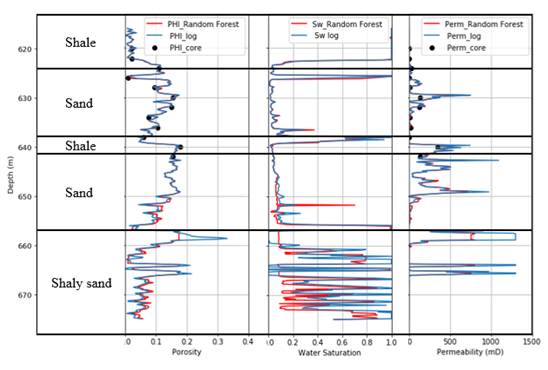
Porosity, permeability and water saturation of the reservoir zone were predicted by the RF analysis, compared with those obtained by the DL analysis and validated with the core easurements. It was found that there is a significant improvement in the analysis running time and the accuracy of the RF-predicted well log answers compared to those results by DL analysis. It is therefore recommended that more applications of RF-based well log analysis be done for clastic reservoirs in Vietnam in the future.
References
Madision Schott, “Random Forest Algorithm for machine learning, Part 4 of a Series on Introductory Machine Learning Algorithms”, 25/4/2019. [Online]. Available: http://medium.com/capital-one-tech/randomforest-algorithm-for-machine-learning-c4b2c8cc9feb.
Tim Kam Ho, “Random decision forests”, Proceedings of the 3rd International Conference on Document Analysis and Recognition, 1995.
Yali Amit and Donald Geman, "Shape quantization and recognition with randomized trees", Neural Computation, Vol. 9, No. 7, pp. 1545 - 1588, 1997.
Tim Kam Ho, "The random subspace method for constructing decision forests", IEEE Transactions on Pattern Analysis and Machine Intelligence, Vol. 20, No. 8, pp. 832 - 844, 1998.
Leo Beriman, "Random Forests", Machine Learning, Vol. 45, pp. 5 - 32, 2001.
Leo Breiman, "Bagging predictors", Machine Learning, Vol. 24, pp. 123 - 140, 1996.
Leo Breiman, Jerome Friedman, R.A.Olshen, and Charles J.Stone, Classification and regression trees. Chapman & Hall/CRC, 1984.
Mohamed Bader-El-Den and Mohamed Medhat Gaber, “GARF: Towards self-optimised random forests”, Proceedings of the 19th International Conference on Neural Information Processing, pp. 506 - 515, 2012.
Simon Bernard, Laurent Heutte, and Sébastien Adam, “A study of strength and correlation in random forests”, Proceedings of the 6th International Conference on Intelligent Computing, pp. 186 - 191, 2010.
Praveen Boinee, Alessandro De Angelis, and G.L.Foresti, Meta random forests, International Journal of Computational Intelligence, Vol. 2, No. 3, pp. 138 - 147, 2005.
Douglas M.Hawkins, The problem of overfitting, Journal of Chemical Information and Computer Sciences, Vol. 44: pp. 1 - 12, 2004.
Shengnan Chen, “Application of machine learning methods to predict well productivity in Montney and Duvernay”, Training course at SPE Canada Unconventional Resources Conference, 17 March 2019.
Toby Darling, Well logging and formation evaluation. Gulf Professional Publishing, 2005.
Pham Huy Giao, “Lecture notes of the CE71.70 course (Petrophysics)”, Asian Institute of Technology, Bangkok, Thailand, 2018.
Pham Huy Giao and Kushan Sandunil, Applications of deep learning in predicting the fracture porosity, Petrovietnam Journal, Vol. 10, pp. 14 - 22, 2017.
Jupyter. [Online]. Available: https://jupyter.org.
P.Simandoux, "Dielectric measurements in porous media and application to shaly formation", Revue de L’Institut Français du Pétrole, pp. 193 - 215, 1963.
1. The Author assigns all copyright in and to the article (the Work) to the Petrovietnam Journal, including the right to publish, republish, transmit, sell and distribute the Work in whole or in part in electronic and print editions of the Journal, in all media of expression now known or later developed.
2. By this assignment of copyright to the Petrovietnam Journal, reproduction, posting, transmission, distribution or other use of the Work in whole or in part in any medium by the Author requires a full citation to the Journal, suitable in form and content as follows: title of article, authors’ names, journal title, volume, issue, year, copyright owner as specified in the Journal, DOI number. Links to the final article published on the website of the Journal are encouraged.


