
Determination of contribution proportion of injection wells in oil production by interwell tracer method using partitioning organic compounds from crude oil
Tóm tắt
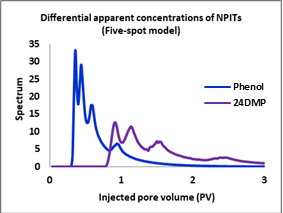
Waterflooding is one of the most common secondary oil recovery methods because of its economic efficiency. In case where many injection wells contribute to the oil recovery process of a production well, contribution proportion will be an important parameter for management of water injection. Besides the well-known Interwell Tracer Tests using artificial tracers injected into the reservoir, the method of using partitioning organic compounds in crude oil as Natural Partitioning Interwell Tracers (NPITs) shows a great potential for evaluating the contribution proportion of injection wells in oil extraction process. The paper presents the research results to illustrate an idea of using NPITs for calculation of the contribution of injection wells to a production well in homogeneous single-layered reservoir on UTCHEM simulation data with Five-spot model and Direct-line model. The results showed that the calculated values of contribution proportion are different from modelling values between 1 - 2%.
Các tài liệu tham khảo
2. Kazuhiro Asakawa. A generalized analysis of partitioning interwell tracer tests. University of Texas. 2005.
3. Nguyễn Hồng Phan, Nguyễn Hữu Quang, Tô Bá Cường, Huỳnh Thị Thu Hương, nnk. Phát triển mô hình mô phỏng quá trình vận động của các chất chỉ thị tự nhiên (NPIT) để đánh giá trữ lượng dầu trong khai thác. Viện Năng lượng Nguyên tử Việt Nam.
4. To Ba Cuong, Nguyen Hong Phan, Nguyen Huu Quang. Interwell tracer method using partitioning compounds naturally existing in crude oil for determination of residual oil saturation. Petrovietnam Journal. 2016; 10: p. 38 - 43.
5. Center for Petroleum and Geosystems Engineering, University of Texas. Reservoir engineering research program: Volume II - Technical documentation for UTCHEM - 9.0 - A three-dimensional chemical flood simulator.2000.
1. Tác giả giao bản quyền bài viết (tác phẩm) cho Tạp chí Dầu khí, bao gồm quyền xuất bản, tái bản, bán và phân phối toàn bộ hoặc một phần tác phẩm trong các ấn bản điện tử và in của Tạp chí Dầu khí.
2. Bằng cách chuyển nhượng bản quyền này cho Tạp chí Dầu khí, việc sao chép, đăng hoặc sử dụng một phần hay toàn bộ tác phẩm nào của Tạp chí Dầu khí trên bất kỳ phương tiện nào phải trích dẫn đầy đủ, phù hợp về hình thức và nội dung như sau: tiêu đề của bài viết, tên tác giả, tên tạp chí, tập, số, năm, chủ sở hữu bản quyền theo quy định, số DOI. Liên kết đến bài viết cuối cùng được công bố trên trang web của Tạp chí Dầu khí được khuyến khích.


